
You’ve probably seen it before; sprinklers running in the middle of a rainstorm, water pooling on sidewalks, or landscapes being irrigated the same way week after week regardless of conditions.
It’s not a system failure. It’s how traditional irrigation has always worked. The problem is that landscapes don’t operate on a fixed schedule.
Weather changes, soil conditions shift, plant needs evolve, yet many irrigation systems are still programmed the same way they were decades ago.
The U.S. Environmental Protection Agency estimates that up to 50% of outdoor water use is wasted due to inefficient irrigation practices.
For contractors, that gap represents both a challenge in system performance and an opportunity to deliver measurable improvements.
That’s where smart controllers are changing the conversation.
From a technical and field perspective, Ian Yarian, Ewing’s National Irrigation Category Manager, and Larry Giorux, Ewing's Commodity Products Category Manager, point to a fundamental shift in how irrigation systems operate today.
Smart irrigation is less about automation and more about adaptability. Systems that respond to real-world conditions instead of following a static schedule.
“At its core, smart irrigation is the ability of a controller to adjust schedules based on real-time site and weather conditions,” said Larry.
Organizations like the U.S. Environmental Protection Agency and the Irrigation Association have worked to define those standards, but in the field, the difference is straightforward: traditional controllers follow a schedule, while smart controllers respond to conditions.
From Static Programming to Dynamic Control
The shift isn’t just conceptual; it changes how irrigation is managed on a daily basis. Control becomes an ongoing process, with the controller continuously adjusting as conditions change. That difference shows up most clearly at the controller.
“Traditional controllers do exactly what they’re told and nothing more,” said Larry. “They’re going to run that schedule no matter what’s happening with the weather or the soil.”
Even when rain sensors are in place, those systems are limited. They can pause irrigation during rainfall but don’t account for how much water has actually reached the soil or how conditions evolve afterward.
Smart controllers take a more responsive approach.
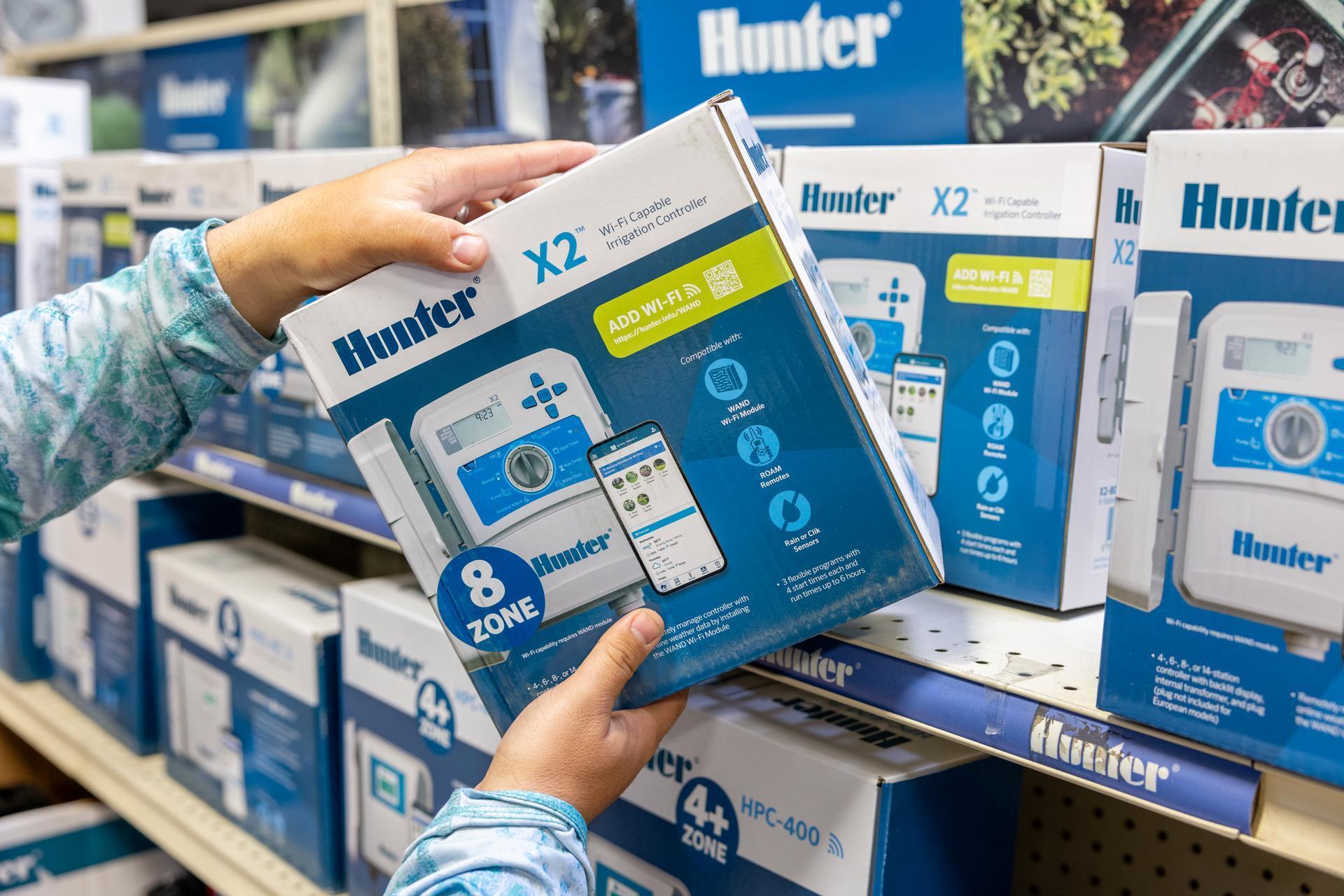
“A smart controller is constantly recalculating based on plant type, soil conditions, and weather since it’s not just running a fixed schedule,” said Ian.
Instead of relying on preset runtimes, these systems continuously evaluate conditions and make adjustments automatically.
EPA WaterSense data shows that more than 28 million U.S. homes have irrigation systems, yet only about 10% currently use smart controller technology.
For many existing systems, that shift doesn’t require a full redesign; it often starts by upgrading or rethinking the controller.
Data-Driven Irrigation
What separates smart irrigation from traditional systems is its reliance on data.
Controllers evaluate multiple inputs, including weather conditions, rainfall, soil characteristics, and plant requirements. At the center of this is evapotranspiration (ET), which measures how quickly water is lost due to environmental factors.
“Solar radiation, wind, and precipitation all influence evapotranspiration rates,” Giorux said. “That combination ultimately drives how much irrigation is actually required.”
According to EPA WaterSense, outdoor water use accounts for roughly 30% of total household demand and can reach up to 60% in arid regions. This makes irrigation one of the largest opportunities for efficiency gains.
Instead of relying on fixed runtimes, smart controllers use this information to determine how long, and whether, to irrigate at all. Adjustments happen automatically, based on actual site conditions rather than assumptions.
Performance in the Field
One of the most immediate impacts of smart irrigation is improved system performance.
Overwatering is one of the most common issues in irrigation, often leading to higher water bills, plant stress, and unnecessary service calls. Smart controllers help address that by applying water more precisely.
EPA WaterSense estimates that smart irrigation controllers can reduce water use by up to 30%, saving roughly 15,000 gallons per home each year.
“When I installed my first smart controller, I reduced my water usage by about 30%, and that translated directly into cost savings,” Ian said.
But efficiency isn’t the only benefit.
“When water is applied correctly, it drives deeper root growth, which leads to healthier, more resilient plants,” Ian added.
That translates to better long-term landscape performance and fewer issues tied to plant health.
Visibility, Protection, and Simpler Setup
Another advantage of smart irrigation is increased system awareness.
With the addition of flow sensors and monitoring capabilities, issues can be detected that might otherwise go unnoticed.
“If there’s unexpected water flow, like a mainline break in the middle of the night, a smart system can detect it and shut things down before it becomes a bigger problem,” said Larry.
This kind of real-time feedback helps prevent water loss, reduce potential damage, and ensure systems are operating as intended.
At the same time, modern smart controllers have become significantly easier to install and configure. Earlier systems required detailed programming and a deeper level of technical input, but today’s controllers incorporate built-in intelligence that simplifies the process.
Many systems can begin optimizing irrigation with minimal setup, which reduces time spent programming while increasing confidence in overall system performance from the start.
A Shift in How Irrigation Is Managed
As water costs continue to rise and expectations around efficiency increase, the role of the irrigation controller is evolving.
Customers are paying closer attention, not just to how their landscapes look, but to how their systems operate. They expect efficiency, consistency, and control.
Smart controllers meet those expectations by delivering systems that adapt automatically, respond to real conditions, and provide greater visibility into performance often without requiring a complete system overhaul.
Smart irrigation isn’t about replacing traditional systems; it’s about improving how they operate.
“The goal is simple: deliver the right amount of water at the right time based on real conditions,” said Ian.
For contractors, that shift creates an opportunity to improve system performance, reduce callbacks, and offer solutions that deliver measurable water savings.
As the industry continues to move in that direction, adaptability is quickly becoming the standard and increasingly, the expectation.
For more data and insights on smart irrigation performance, view our full infographic.

